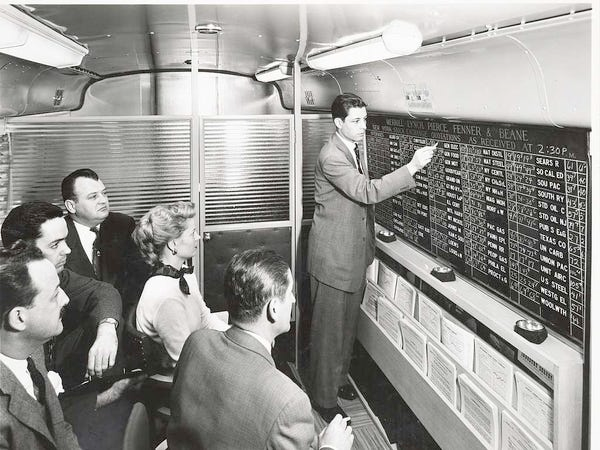
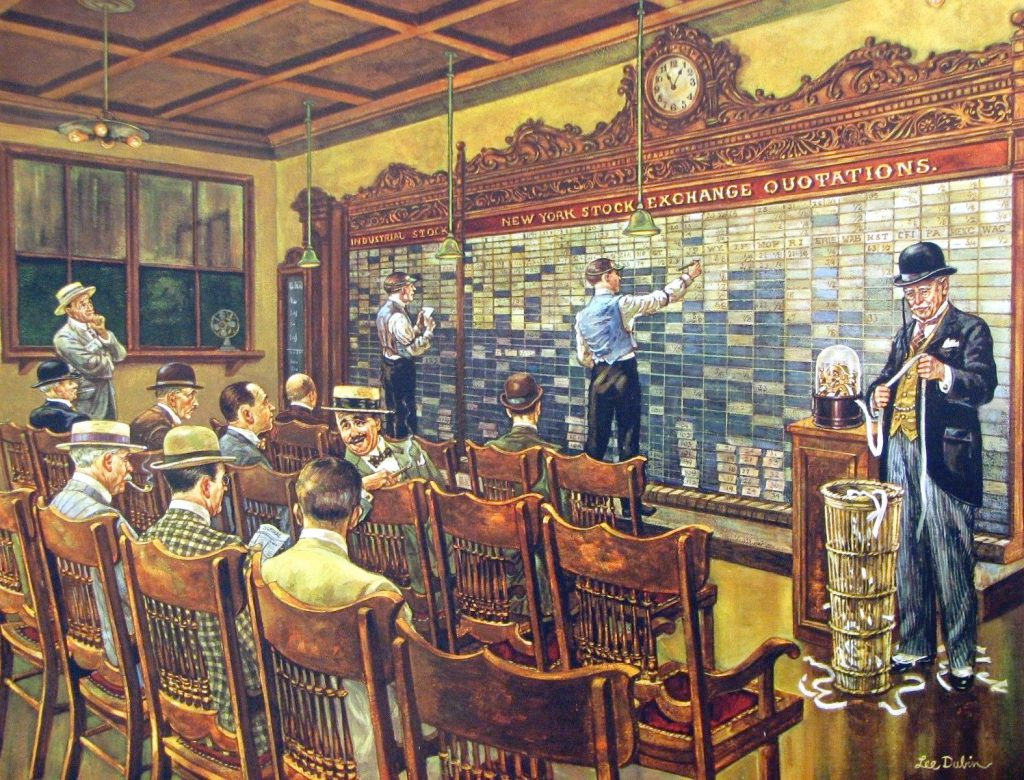
When Jesse Livermore began his career at the turn of the twentieth century, financial markets were not yet engines of capital formation but theaters of speculation. In Reminiscences of a Stock Operator (1923), the book describes an apprenticeship inside the bucket shops of Boston—smoky rooms where men wagered on the rise and fall of stock prices that never actually changed hands. It was there—amid the ticking of telegraph tape and the murmur of bettors—that he discovered the oldest truth in finance. The crowd will always speculate, and the house will always win.
A bucket shop was not a brokerage so much as a mathematically perfected extraction machine. The structural genius lay in its simplicity: by internalizing all order flow and becoming the sole counterparty to every trade, the shop transformed itself from intermediary to adversary. Every customer loss became house profit. Every position could be managed, every price shaded, every margin call timed. The customers thought they were trading against the market; they were actually trading against the house’s balance sheet.
The Mechanics of the Trap
Shops required margins as low as one percent—a policy that ensured maximum leverage and minimal chance of survival.
Their internal prices, while tracking real exchanges, would mysteriously spike or gap during thin trading, triggering cascades of forced liquidations.
The shops controlled three critical functions that should never exist in the same entity: price discovery, order execution, and position liquidation.
This trinity of control meant the house could manipulate each lever to ensure customer failure.
Three functions that should never exist in the same entity. — select each node.
Consider the information architecture. Real exchanges published prices that traveled by telegraph to the shop, where they were transcribed onto quote boards. In that transcription lay opportunity—a half-point deviation here, a delayed update there, a sudden spike that existed nowhere else. Customers could only see the shop’s boards, not the real exchange prices. They were betting on shadows of shadows, derivatives of derivatives, prices that existed only on the shop’s boards.
Shop operators understood portfolio mathematics decades before the advent of modern risk management. They knew that with enough customers taking both sides of a bet, they could profit from the spread and commissions alone. When positions became unbalanced, however, and too many customers bet in the same direction, the shops would shade prices to trigger liquidations on the crowded side. It was not fraud, technically, but rather the systematic exploitation of structural advantages.
The narrator learned to see through the architecture. Livermore—or rather, the character based on him—became so successful at reading the tape and predicting short-term movements that he was eventually banned from every bucket shop in Boston, forced to trade under assumed names or through proxies. The shops could tolerate lucky customers but not systematic winners.
“There is nothing new in Wall Street. There can’t be because speculation is as old as the hills. Whatever happens in the stock market today has happened before and will happen again.”
A Parallel Financial System
The proliferation of bucket shops in the early twentieth century created a parallel financial system—one that looked like real markets but operated on inverted principles. The differences were categorical:
Congressional investigations and state regulatory filings from the era revealed the systematic nature of customer destruction. Contemporary accounts suggest that the vast majority of bucket shop patrons—by some estimates over ninety percent—lost their entire stake within months, a statistical near-impossibility in real markets but a mathematical certainty in a system designed for extraction. The shops were not competing on service or execution quality; they were competing on how efficiently they could convert customer deposits into house profits.
One might expect that such a transparently extractive model would have no modern parallel.
Thank goodness modern technology has eliminated such antiquated conflicts of interest. Today’s traders enjoy the complete confidence that comes from transparent prices, verifiable ownership, and platforms that would never dream of trading against their own customers.
And yet the structural parallels are difficult to ignore. Today’s offshore crypto derivatives exchanges—many of which internalize order flow, act as counterparty, and control liquidation engines—concentrate the same trinity of functions that defined the bucket shops of a century ago. The scale, however, is new. Open interest in crypto derivatives now runs into the tens of billions, spread across platforms whose internal mechanics remain largely opaque to the traders using them.
- Lefèvre, Edwin. Reminiscences of a Stock Operator. George H. Doran Company, 1923.
- Hochfelder, David. “Where the Common People Could Speculate”: The Ticker, Bucket Shops, and the Origins of Popular Participation in Financial Markets, 1880–1920. Journal of American History, Vol. 93, No. 2 (2006), pp. 335–358.
- U.S. Congress, House Committee on Banking and Currency. Hearings on the Regulation of the Stock Exchange. 63rd Congress, 2nd Session, 1914.
- Cowing, Cedric B. Populists, Plungers, and Progressives: A Social History of Stock and Commodity Speculation, 1868–1932. Princeton University Press, 1965.
- Smitten, Richard. Jesse Livermore: World’s Greatest Stock Trader. John Wiley & Sons, 2001.
- AmberData / CoinShares. Crypto Derivatives Open Interest by Exchange. Data as of October 13, 2025.