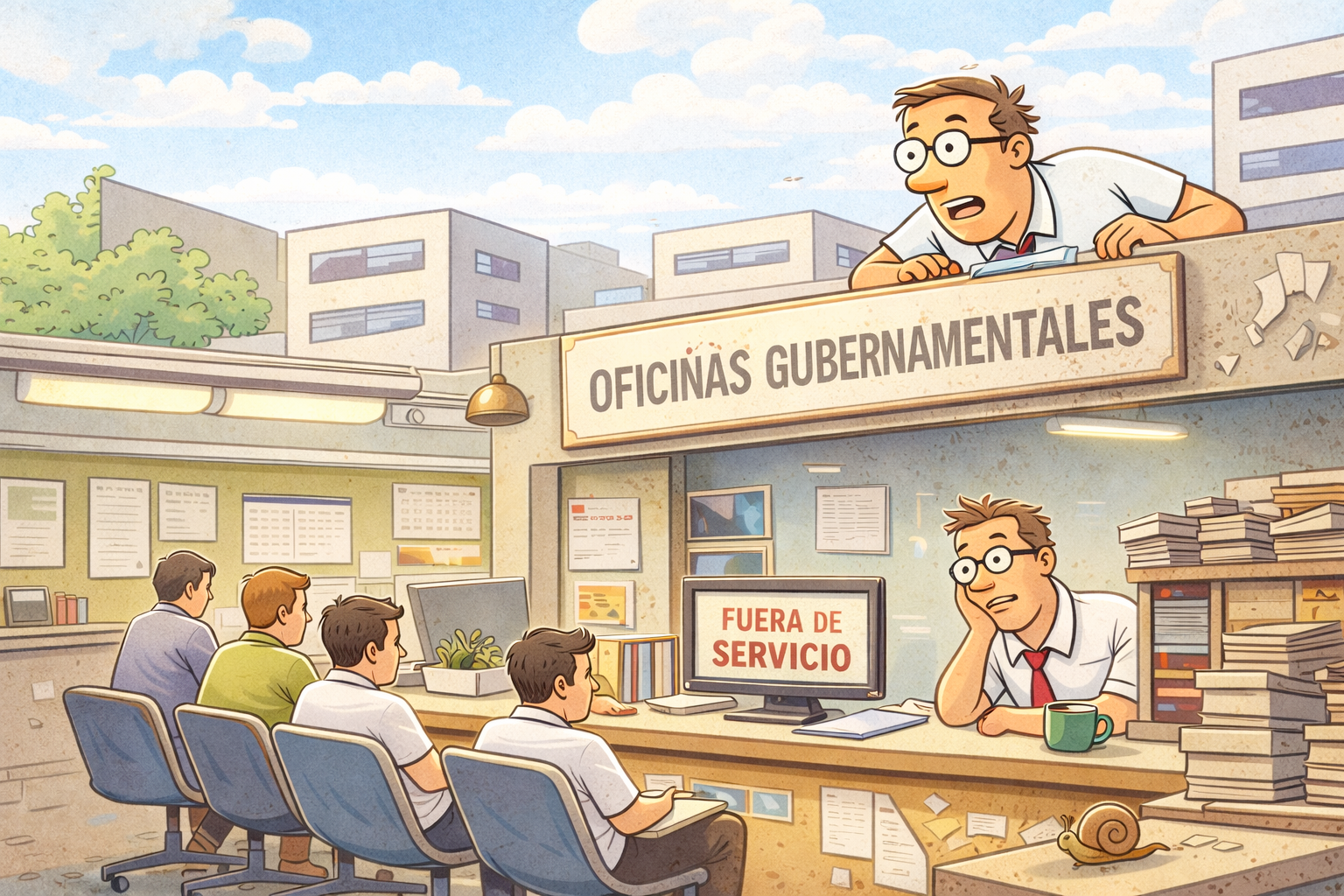
There are two ways a country loses its competitive position.
The first is dramatic: currency collapse, expropriation, political rupture.
The second is gradual: institutional decay so normalized it becomes invisible.
Mexico is experiencing the second.
The Cost No Model Captures
Every underwriting model accounts for taxes, labor costs, currency risk. Few account for friction—the accumulated weight of systems designed not to function, but to persist.
Consider what the World Bank found before it discontinued its Doing Business report in 2021, following an independent investigation into data irregularities in several country rankings. Despite its methodological controversies, the final 2020 edition remains the most comprehensive cross-country comparison available. Mexico ranked 120th globally in paying taxes. Not only because of rates, but because of what happens after you file.
The Post-Filing Index—a measure of what it takes to correct an error, claim a refund, or resolve a dispute with the tax authority—scored Mexico at 40.5 out of 100. The OECD average is 86.7. Brazil, infamous for bureaucratic complexity, scored 7.8.
Mexico is closer to Brazil than to its trade partners.
A VAT refund request takes 8 weeks in the United States. In Mexico, it takes 42.
These numbers translate into time.
A taxpayer who discovers an error in a corporate filing and attempts to correct it faces a 45-week process. Combined with a VAT refund claim, the total post-filing burden reaches 87 weeks — nearly two years spent navigating a system with which the taxpayer initiated contact.
42 weeks
45 weeks
87 weeks
Our recent interaction with Mexico's tax authority was true to form. That is precisely the problem. Appointments that do not exist, criteria that shift between officials, a bureaucracy that neither approves nor denies, but simply delays. The implicit message to any enterprise seeking formality: stay small, stay quiet, stay informal.
The Architecture of Friction
What makes Mexico's institutional decay distinctive is not its severity but its comprehensiveness. The friction is not concentrated in one agency or one process. It is distributed across the entire architecture of doing business.
Starting a company costs 16.3% of income per capita — 5.3 times the OECD average.
Construction permits run 10.9% of warehouse value versus 1.5% elsewhere.
Connecting a facility to the electrical grid requires 264% of per capita income. In OECD countries, the same connection costs 63%.
That is a 4.2× multiplier before a single kilowatt of revenue has been generated. The pattern reveals itself not in any single data point but in their accumulation.
Each friction, individually, seems manageable. Together, they constitute a tax on formality that compounds with every transaction.
The Corruption That Does Not Make Headlines
Large-scale corruption attracts attention. Small-scale corruption attracts resignation.
Files disappear, signatures never arrive, and processes restart without explanation — all of it wasting time.
Mexican businesses spend 241 hours per year on tax compliance alone, 50% more than their American counterparts.
Mexico's compliance burden, though lower than the Latin American average of 317 hours, is not the worst in class. The issue is that Mexico competes against OECD economies while operating with outdated infrastructure.
This inefficiency is structural, embedded in systems that were never designed to communicate. Mexico has made strides — CFDI electronic invoicing and the SAT digital platform are genuine improvements — but digitizing the front end of a broken process does not fix the process itself.
The Nearshoring Paradox
The investment case appears obvious: global supply chains are restructuring, proximity to the United States matters more than ever, and Mexico sits at the geographic center of the opportunity. Yet the data tells a different story.
Multinational expansions
Nearshoring announcements
Supply chain restructuring
Relocations to Austin, Miami
Young professionals to Madrid
Brain drain accelerating
The same week a multinational announces a Monterrey expansion, a mid-sized Mexican company quietly opens a Delaware LLC. The same month foreign direct investment hits a record, a generation of young professionals update their LinkedIn locations to Austin, Miami, Madrid — a pattern the Wilson Quarterly has documented as a structural brain drain that undermines the very workforce nearshoring demands.
Institutions do not fail all at once. They fail when the cost of compliance exceeds the cost of evasion, when formality becomes punishment rather than protection, and when honest operators look at informal ones and begin to question their own choices. Mexico has not crossed that threshold. However, the distance is narrowing.
At Denaris, we believe in the long-term potential of the region. Yet we also believe in seeing clearly. What we see is a country where the distance between opportunity and execution remains, year after year, frustratingly wide.
Capital will continue to flow. The only question is whether Mexico will be a destination or a detour.
- World Bank Group. Doing Business 2020: Economy Profile — Mexico. Washington, DC, 2020.
- World Bank Group. Doing Business 2020: Comparing Business Regulation in 190 Economies. Washington, DC, 2020.
- World Bank Group. Independent Review of the Doing Business Report. September 2021.
- Wilson Quarterly. The Other Immigrants: Why Mexico's Brightest Get Lured to the U.S.
- Servicio de Administración Tributaria (SAT). CFDI electronic invoicing documentation.